Our Blog Has Moved

Showing posts with label Fruit Vinegar. Show all posts

25 August 2015

Womersley Foods exhibiting at Speciality & Fine Food Fair 2015

The Speciality & Fine Food Fair is coming to London, Olympia on 6th – 8th September 2015 and there will be a number of Artisan Food Trail members exhibiting at the trade show.

Womersley Foods will be on stand V58 showcasing their 'Drop dead gorgeous' fruit and herb vinegars.

Whilst the making of fruit vinegars is a fine old British tradition, Womersley we are proud to say that they have perfected recipes which will delight and surprise you. The recent popularity of drinking vinegars has further increased the profile of Womersley fruit vinegars.
Their multi-award winning vinegars all contain generous quantities of the rich fruits which give them a luxurious finish.
Visit their stand to try the new fruitier recipes to discover how delicious they are and why they are a must for all fine food outlets.

More information about Womersley Foods here
Find them on Stand V58 at the Speciality & Fine Food Fair
______________________________________________________________

13 March 2014

Spring Sale in the foodbyalancoxon.com shop

Photo: © childsdesign

***   
Chef Alan Coxon is currently running a special spring promotion on selected products available to buy online from foodbyalancoxon.com.

There are considerable savings to be had on Roman Vinaigre, Ancient Greek Vinaigre and the complete range of fruit vinegars.
Roman Vinaigre was £13.95 is now £6.50; Ancient Greek Vinaigre was £14.95 now £7.50 and the fruit vinegars were all £9.95 now £6.95 each.

If you've never tried any of these vinegars before, now would be a good time to place an order. We can thoroughly recommend them too.

21 February 2014

Ricotta Pancakes with Marinated Blood Oranges

Photo: © childsdesign

***  
Pancake Day is only just a round the corner so we thought it about time we included a recipe from the AFT Kitchen to try on the day.
These pancakes are perhaps a little different from the usual in that they contain ricotta cheese and the way they are prepared produces a very light and fluffy result.

Taking inspiration from the traditional citrus accompaniment and crepe suzette we chose to serve them with marinated oranges. We managed to pick up some delicious blood oranges which are not only gloriously coloured but also have a good intense tangy flavour.
We enhanced the flavours further with the addition of Orange & Mace Vinegar from Womersley Fruit & Herb Vinegars which gave a little fragrant spiciness.

View recipe

20 February 2014

Approved: Womersley’s Orange & Mace Vinegar

Photo: © childsdesign
Sometimes we wonder what we did before we had the pleasure of using flavoured vinegars in our cooking. Working with several producers on The Artisan Food Trail has introduced us to some interesting fruit infused vinegars all of which are individual in their own right.

Read full review

We are pleased to award Womersley Fruit & Herb Vinegars our 'Artisan Food Trail Approved' status for their Orange & Mace Vinegar.


To find out more about Womersley Fruit & Herb Vinegars visit their page on The Artisan Food Trail here.

9 October 2013

New seasonal fruit vinegars added to Alan Coxon's range


***   
We're excited to tell you about a new addition to Alan Coxon's vinegar range. Those of you who've visited his stand at any recent events may have already seen them.

Alan Coxon has used his multi-award winning historic Roman and Ancient Greek Vinaigres as the base in which to add and blend soft fruit flavours such as Raspberry, Strawberry, Passion Fruit and Blackcurrant.

These four fruity vinegars create a stunning new collection offering fresh vibrant and zingy taste sensations adding more fun and culinary adventures to the kitchen and plate. Whilst these are new to Alan’s food line and range, the fruits and vinegars themselves have been made for centuries.

The fruit vinegars are a special edition reflecting the changing seasons.
We hope you like the labels too as Alan asked us rustle up a quick 'fun, fresh and fruity' idea to add to the bottles.

To find out more about these vinegars and to purchase online visit foodbyalancoxon.com

16 July 2012

A Cherry on Top for National Cherry Day

Photo: © childsdesign

When travelling around Britain it is not difficult to notice that the word orchard is synonymous with many roads, avenues, views, places etc., but the most unnerving thing is that these locations do not lead to vast collections of fruit trees, but instead they are occupied by housing developments.
Once, Britain was covered with acres of majestic cherry trees, but these have given way to our burgeoning population and they’ve also suffered losses due to the Second World War that demanded other types of food production to be implemented to save our country from starvation, not to mention the further collapse of the cherry growing industry due to foreign imports.

Growers are being encouraged to reinstate the great British cherry by planting up new orchards with old varieties and with National Cherry Day on 16th July we should all be buying and using British cherries.

Are cherries native to Britain?
Wild cherries (Prunus avium) have been eaten in Britain since prehistoric times. The Romans had a particular taste for them too and it is said that it’s possible to trace the route of ancient roads by the cherry trees growing there. Romans marching through Britain would munch on cherries, spitting out the stones as they went, and new trees grew as a result.

It seems there are many theories about how the cherry came to Britain, its origins beginning in the area between the Black and Caspian Seas of Asia Minor and suggestions that birds consuming the fruit would have deposited the pips in their droppings over Europe.

Photo: © childsdesign


History and cultivation
Cultivation probably began with the ancient Greeks and perpetuated by the Romans, where it was believed to be an essential part of the Legionnaires’ diets.
During the Middle Ages cherries were a common sight in gardens and were sold in street markets, however, at this time, Europe was still the main source of the fruit, where the climate afforded a more plentiful crop.

It wasn’t until the sixteenth century that heavier cultivation took place, Kent becoming the centre of Britain’s fruit growing due to good transport links to London’s markets and the connection with growers and gardeners across the Channel.

It was customary to cultivate cherry trees as tall standards with grass beneath. The orchards would be grazed by sheep. Until the twentieth century rootstocks were obtained from the wild cherry which produced towering trees, requiring long ladders to pick the fruit. Climbing so high was not always appealing as well as dangerous so producers began experimenting with less vigorous rootstocks to produce shorter trees but still giving a high fruit yield.

The science bit (sort of)
As with most fresh fruit it is not surprising to know that cherries are good for us. Cherries contain anthocyanins, the compound that makes them red. Anthocyanins have been shown to have antioxidant properties, which can guard against certain cancers and diabetes. Other studies have shown that cherries can also help to ease the pain of arthritis, fight memory loss, lower cholesterol and help our sleep patterns. And to top it all they contain 20 times more beta carotene than blueberries.

Cherries do pack a lot of goodness but they also contain cyanide. Our bodies are able to break down the small quantites that the fruit contain, so there’s no need for concern. The toxin is greatly concentrated in the pips, but if one or two were swallowed, no harm would occur as they’re unlikely to be broken down enough in the digestive system.

What is the best way to serve them?
When the cherries are red, shiny and fully ripe and in their prime, then eat them as they are. They need no accompaniment, just simply plucked from the bowl and enjoyed at their natural best.

Cherry and Goat's Cheese Salad.
Recipe here
Desserts, are of course, one of the most-fitting ways to use them, most obviously pies and tarts or the clafoutis a French dish where marinated cherries are cooked in a rich batter. Cherries are also a perfect partner to chocolate too.
They can be made into a traditional sauce for duck or game, and they ideally complement soft white cheeses as well.
Try them with Smoked Duck from The Artisan Smokehouse.

Womersley Fruit and Herb Vinegars make a Cherry Vinegar which they say is a heavenly match for Italian cuisine. It can be married with Parma Ham, grilled scallops and mozzarella salads, or united with desserts that have lashings of chocolate, mascarpone and ice-cream. The robust character makes it good to add to sauces for duck and turkey, or teamed with sparkling wine for a vivid aperitif.

Cherry picks
Some interesting and fun facts about cherries
:: Charles V of France loved cherries so much, he planted more than 1000 trees in his garden.
:: Hot cherry stones were used in bed pans to warm beds.
:: The word ‘cherry’ comes from the French word ‘cerise,’ which in turn comes from the Latin words cerasum and Cerasus, the classical name of the modern city Giresun in Turkey.
:: Cherries are drupes, or stone fruits, and are related to plums, peaches and nectarines.
:: The world's heaviest cherry was grown by Gerardo Maggipinto (Italy) and weighed 21.69 g on June 21, 2003. The cherry was presented at La Grande Ciliegia, in Sammichele di Bari, Italy.
:: In Japan, the cherry symbolises the brevity of life. The saying goes ‘The cherry is among flowers as the samurai is among men’.
:: If you dream of cherries...
Ripe cherries off the tree mean success and happiness .
Eating cherries means possession of something desired
.
A cherry tree is an omen of good fortune.
:: The name for cherry liqueur – Kirsch – comes from the Mesopotamian karshu, the word for the first cultivated cherries in Mesopotamia in 8BC.
:: Shakespeare used cherries as a symbol of love and romance in A Midsummer Night's Dream.
:: A posh pudding in country houses a couple of centuries ago was to have small cherry trees grown in pots and brought to the table with the fruit still hanging on the branch.

30 September 2011

New bottle sizes, gift pack and a new product from Womersley Fruit & Herb Vinegars

The complete vinegar range from Womersley Fruit & Herb Vinegars will be also be available in new smaller sized 100ml bottles. Launching from 1st October 2011, just in time to think about selecting those Christmas presents, the small bottles are ideal as gifts. You will be able to buy gift packs containing 3 x 100ml, presented in an attractive and convenient box – perfect for any enthusiastic cook.

To brighten up you food at Christmas time, Womersley Fruit & Herb Vinegars have brought back one of their old favourites, Orange and Mace, full of festive warmth and aroma.

To find out where and how to buy, either in stores or online click here

For more information about the range you can download the current information leaflet below


Visit Womersley Fruit & Herb Vinegars on The Artisan Food Trail here

20 September 2011

Essence of Taste: Womersley Fruit & Herb Vinegars


The Womersley brand was launched by Martin and Aline Parsons from their home, Womersley Hall, in 1979 and has become one of Yorkshire’s and England's leading Gourmet Brands.

The home-grown specialist herbs and fruits are the key ingredients of all their fruit and herb vinegars and jellies. Martin attributes his expert knowledge of speciality herbs to his family's background. The Parsons family has lived in Yorkshire for generations and is famous for grand gardens and horticulture at Nymans in Sussex and Birr Castle in Ireland. Martin's instinctive ability to blend specialist herbs and sumptuous fruits with vinegar and sugar has created for cooks and chefs a product of such versatility and has led them to win numerous taste awards.


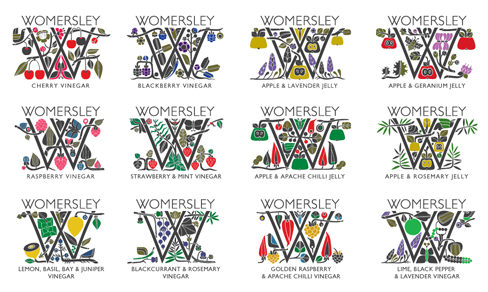
In 2009, Martin and Aline's son, Rupert, took on the privilege of running Womersley. Since doing so, he has overseen the move to a bespoke new, and larger, premises as well as rebranding the company image – the beautiful labels are the work of Swedish artist, Petra Borner

Whilst the making of fruit vinegars and herb jellies is a fine old British tradition, at Womersley they are proud to say that they’ve perfected recipes which will delight and surprise.

The jellies are soft-set, jewel-coloured and translucent. The recipe is balanced to allow maximum versatility in the kitchen, whilst ensuring that the true aromas of all the flavours always shine through whether that is geranium, rosemary, apache chilli or lavender. They only use the natural pectin in the apples as the setting agent.

The multi-award winning vinegars all contain generous quantities of the rich fruits which give them a luxuriously thick finish. The range of flavours can be used in the making of or to accompany almost any dish.

Visit Womersley Fruit & Herb Vinegars on The Artisan Food Trail here